The short answer: Sanur is Bali’s most livable long-term base
for families, remote-working couples who prefer calm to scene, and
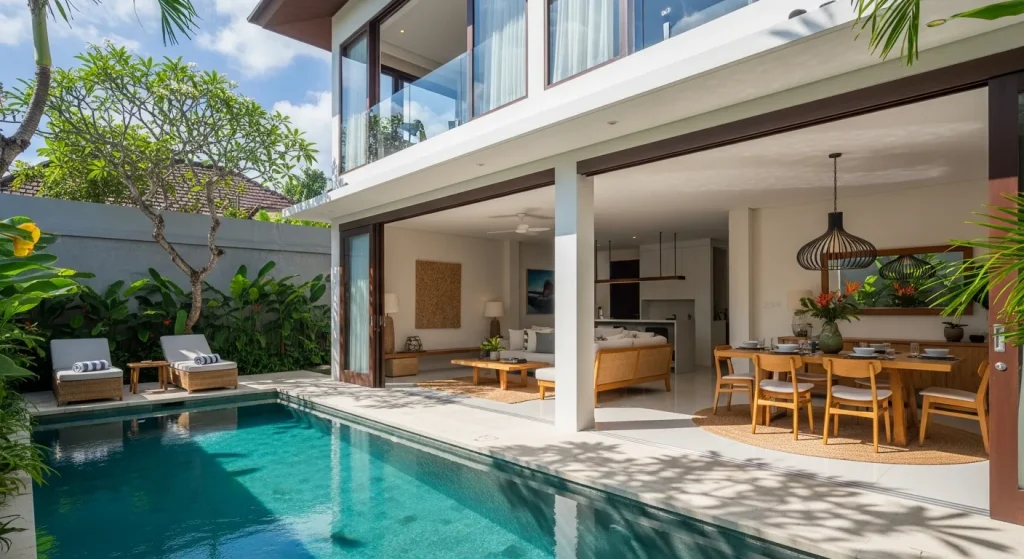
anyone over 45 — with 2027 rents of Rp 8–13 million monthly for a
one-bedroom, Rp 15–25 million for a two-bedroom villa, and genuinely
large yearly family houses from Rp 200 million per year. What you trade
for that is nightlife, novelty, and a bit of edge.
Sanur was my first home in Bali. I arrived twelve years ago, rented a
two-bedroom house off Jalan Danau Poso, and stayed four years before the
rest of the island pulled me west. I still send a steady stream of
clients there — often the ones who tried Canggu first.
What Sanur actually is
Sanur runs along Bali’s southeast coast: a reef-protected,
east-facing beach with a paved path stretching roughly five kilometers
from Matahari Terbit down to Mertasari. Behind the beach sit three
parallel worlds: the hotel strip on Jalan Danau Tamblingan, a
residential grid of lanes named after Indonesian lakes (Danau Poso,
Danau Buyan, Danau Tempe), and the workaday Indonesian town along the
Bypass Ngurah Rai. Unlike Bali’s newer expat zones, Sanur was never
built for foreigners — it grew around a mixed community of
Balinese families, long-settled Europeans, and Indonesian professionals,
and it shows in the best way: functioning pavements, mature trees,
established everything.
The 2027 wrinkle: the area around the Bali International Hospital
campus in Sanur’s special economic zone has brought new apartments, new
cafés, and new demand at the northern end. Sanur is quietly getting
younger.
Rents in 2027: what your
money gets
| Property type | Monthly (furnished) | Yearly (upfront) |
|---|---|---|
| 1BR guesthouse or apartment | Rp 8–13M | Rp 80–130M |
| 2BR villa with pool | Rp 15–25M | Rp 150–250M |
| 3BR family house, garden | Rp 25–40M | Rp 200–320M |
| 4BR compound-style home | Rp 35–55M | Rp 300–450M |
Three Sanur-specific realities behind those numbers:
- The stock is older and larger. Much of it is
1990s–2010s houses with real gardens, not new-build villas. Some of the
best value is unfurnished on 2–5 year terms — ideal if you’re
actually settling. - The market is a word-of-mouth market. The lanes off
Danau Tamblingan and Danau Poso are full of homes that rent through
neighbors, temple networks, and long-standing caretakers. The portals
show Sanur’s worst value, not its best. - Yearly upfront is still king. Owners here are
traditional; a year paid in advance unlocks discounts of 15–25% versus
monthly structures — which makes contract diligence essential before
money moves.
The streets, decoded
- Beach side of Jalan Danau Tamblingan (Batujimbar,
Semawang): the premium pocket — walk to the beach path, cafés
at your corner. Priciest, occasionally noisy near hotels. - Lanes off Jalan Danau Poso (south Sanur): my old
neighborhood and still my top recommendation for families — quiet gangs,
big gardens, five minutes’ cycle to Mertasari beach. - North Sanur (Jalan Hang Tuah / Matahari Terbit):
convenient for the harbor’s fast boats to Nusa Lembongan and Penida;
busier, more mixed. - West of the Bypass (Renon direction): noticeably
cheaper, more Indonesian, brilliant food — but you lose the
walk-to-beach life that is Sanur’s whole point.
Daily life: the honest ledger
What’s genuinely great. The beach path is Sanur’s
social spine — sunrise joggers, kids on bikes, grandparents, dogs (mine
included). The sea inside the reef is calm and swimmable at mid-to-high
tide. Traffic is the lightest of any major expat area. Markets like
Sindhu give you produce at Indonesian prices. And the community is
stable: the friends you make in Sanur are still there in three
years, which is not something Canggu can promise.
What people miss. Nightlife essentially ends at
22:00 — a handful of relaxed bars, then quiet. The restaurant scene,
though vastly improved, is a step behind the west coast in variety. Surf
inside the reef is a non-event (surfers commute to Serangan or the
Bukit). Twentysomethings often find it slow within a month — Sanur’s
nickname “Snore” is unfair but not baseless.
Practical notes. Fiber internet is reliable across
the grid (Rp 400–700K/month). Getting anywhere west — Canggu, Uluwatu —
means crossing or skirting Denpasar; the Sunset Road corridor at 17:30
is the price Sanur residents pay for their quiet streets. For everyday
needs, pharmacies, clinics, and international-standard facilities are
closer at hand than anywhere else on the island. For broader
arrival-and-visitor context, Bali’s provincial statistics office
publishes the underlying trends at bali.bps.go.id.
Who Sanur suits — and who it
doesn’t
Sanur fits you if: you have young children (calm
sea, flat streets, established schooling nearby); you’re a couple or
single who works from home and wants peace with infrastructure; you’re
retiring or semi-retiring; or you simply want the lowest-friction
version of Bali life.
Look elsewhere if: your social life needs a scene
(Canggu), you surf daily (the Bukit — see our Uluwatu long-term guide),
or you want jungle rather than sea (Ubud). Our full guide to the best areas to live in
Bali sets Sanur against every alternative honestly.
A resident’s verdict
Sanur is where Bali stops performing and starts functioning. It won’t
photograph as well as a Pererenan rice-field villa, and nobody moves
there to reinvent themselves. But of the nine leases I’ve signed on this
island, the Sanur years were the easiest ones — and when clients tell me
they want to live in Bali rather than consume it, Sanur is
usually the first place I show them.
Find your Sanur home
We keep current, vetted long-term options across Sanur — beach-side
lanes, family houses off Danau Poso, and yearly unfurnished homes that
never reach the portals. Tell us your budget, household (kids? pets?),
and move-in month via Bali Expat Housing, and we’ll
reply with real options within 24 hours.
Start your inquiry or
WhatsApp the team: wa.me/6281128590000.
Rent figures from contracts and owner quotes handled by Bali
Expat Housing, Q4 2026–Q1 2027. Indicative ranges, not offers.