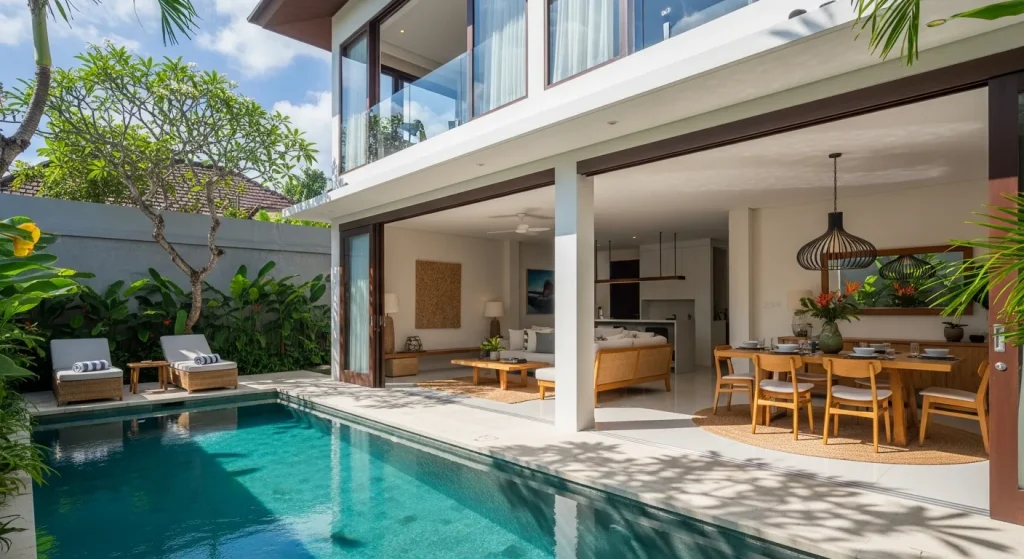
The short answer: an Umalas long-term rental in 2027 runs Rp
9–14 million per month for a one-bedroom and Rp 18–28 million for a
two-bedroom pool villa — 20–30% below Canggu prices, fifteen minutes
from Canggu’s schools and cafés, with quieter lanes and longer-staying
neighbors. Kerobokan, wrapped around it, drops prices another 10–15%.
Together they’re the smartest value in southwest Bali for people who
actually live here.
I spent three years in Umalas between my Sanur and Pererenan
chapters, and I still consider it the island’s most underrated address.
It’s the area clients thank me for six months later — rarely the one
they arrive asking about.
Where and what this area is
Umalas sits inland between Kerobokan and Canggu, threaded by two
spine roads — Jalan Umalas I and Jalan Umalas II, linked by Jalan Bumbak
— with rice-field lanes running off them. Kerobokan is the bigger,
busier, more Indonesian district surrounding it: markets, furniture
workshops along Jalan Padang Linjong and Jalan Petitenget’s upper
reaches, and dense local life. Neither has a beach; both are 10–20
minutes from several (Batu Belig, Berawa, Petitenget).
The character difference from Canggu is immediate: fewer scooters
with surfboard racks, more school runs; fewer beach clubs, more family
compounds; ceremonies on the lane instead of ring lights. Umalas has
quietly become the settling-down neighborhood for people who did their
loud Canggu year and want the same access with less theater.
2027 rents: the value case
in numbers
| Property type | Umalas (monthly) | Kerobokan (monthly) | Yearly (upfront, Umalas) |
|---|---|---|---|
| 1BR apartment/guesthouse | Rp 9–14M | Rp 7–12M | Rp 90–140M |
| 2BR pool villa | Rp 18–28M | Rp 15–24M | Rp 180–280M |
| 3BR family villa | Rp 30–48M | Rp 25–40M | Rp 280–420M |
Compare that with Canggu’s Rp 25–40M for the equivalent two-bedroom
and the arithmetic writes itself: the same annual budget buys
you a bigger house, a real garden, and change for two return flights
home. Increases here have run 5–8% on new contracts — half the
coastal pace — because supply is steadier and the tenant base renews
rather than churns. (Island-wide numbers and the full cost stack —
utilities, deposits, banjar contributions — are in our Bali rental costs 2027 guide.)
Stock worth knowing about: Umalas has an unusual concentration of
older 2000s-era villas on generous plots — less
Instagram, more livability — plus a genuine yearly-house market that
circulates by word of mouth among the area’s staff, drivers, and
long-term residents. That off-portal layer is where the value hides, and
it’s the layer we work in daily at Bali Expat
Housing.
Daily life: what
the middle ground feels like
Position is the product. From Jalan Bumbak you’re
10–15 minutes to Berawa’s schools and gyms, 15 to Seminyak’s
restaurants, 20 to Batu Bolong — close enough for everything, far enough
that none of it wakes you. For households split between a Canggu school
run and a Seminyak office, Umalas is the geometric answer.
Quiet, with asterisks. The lanes are calm, but the
two Umalas spine roads carry real through-traffic at peak hours now —
Canggu’s overflow found the shortcuts years ago. When we assess a villa
here, road position matters as much as the villa itself: fifty meters
down a gang is worth a million rupiah a month of peace.
Kerobokan’s bonus. Living on the Kerobokan side puts
you inside a working Indonesian town: the morning market, warungs at
local prices, tailors and workshops. Your monthly cost of living drops
noticeably compared to villa-belt life. The trade is aesthetic — busier
roads, less curated prettiness.
Family practicalities. Fenced gardens are more
common here than anywhere west of Sanur; the school corridor is minutes
away; and the neighborhood’s longer average tenancy means kids keep
their friends. Fiber internet is solid on both spine roads (Rp
400–700K/month). Everyday clinics and pharmacies sit within ten minutes
in any direction.
Choosing your lane
(literally)
- Jalan Umalas I side: closer to Kerobokan’s
amenities; denser, better warung access. - Jalan Umalas II / Bumbak toward Canggu: newer
stock, closest to Berawa schools — priced accordingly. - Rice-field gangs between them: the sweet spot —
quiet, green, five minutes from everything. Also where construction can
start next door: ask the banjar (or ask us to ask) what’s approved on
neighboring plots before signing a multi-year lease. - Kerobokan proper (Padang Linjong, Tegal Cupek):
best pure value; choose a gang, not a main road.
Who should live here —
and who shouldn’t
Umalas/Kerobokan fits: families anchored to the
Canggu school corridor who don’t want to live in the corridor; couples
settling in for multi-year stays; anyone whose budget stopped matching
Canggu but whose life is still built around it.
It won’t fit: first-timers who came to Bali for the
beach-bar postcard (you’ll feel like you’re commuting to your own
holiday), or surfers who measure their life in paddle-out minutes — the
Bukit or Canggu serve you better. See how these neighborhoods compare
across the whole island in our best areas to live in Bali
guide.
A note on the numbers
behind the trend
The southwest’s inland belt keeps absorbing residents as coastal
prices climb — a pattern consistent with the sustained growth in foreign
arrivals and stays that Bali’s provincial statistics office documents at
bali.bps.go.id. Umalas won’t stay
underrated forever; the 2027 gap to Canggu is already narrower than
2024’s. The window is open, not permanent.
See the homes that
never hit the portals
Tell us your budget, move-in month, and household — kids, pets,
home-office needs — and we’ll send real, currently available Umalas and
Kerobokan options within 24 hours, including the yearly word-of-mouth
houses.
Start your inquiry or
WhatsApp the team: wa.me/6281128590000.
Rent figures from contracts and owner quotes handled by Bali
Expat Housing, Q4 2026–Q1 2027. Indicative ranges, not offers.