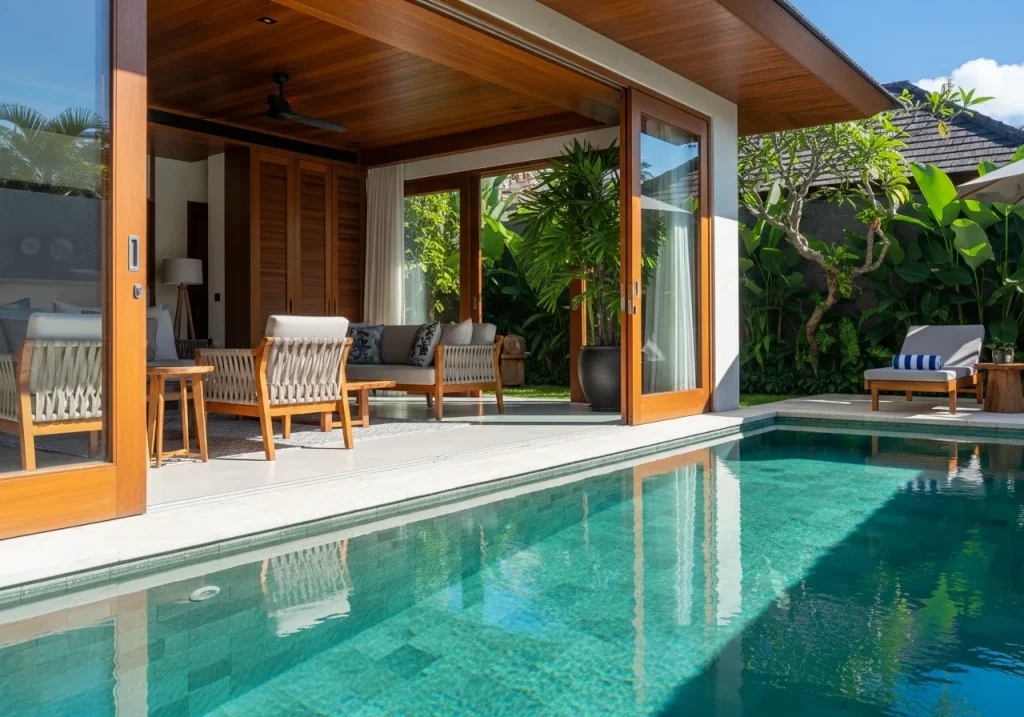
For Bali expat housing, buying offers potential capital appreciation (5-12% annual growth) for villas typically priced USD 300k-550k, while renting provides flexibility, lower upfront costs, and access to a broad range of Bali expat accommodation, including short-term and long-term options.
Bali Expat Housing: Buying vs. Renting
Understanding the nuances of Bali expat housing, are considering buying or renting, is crucial for long-stay professionals, families, remote workers, and expats relocating to the island. Bali Expat Housing provides a clear guide to the market dynamics, typical costs, and legal frameworks for both options.
1. Bali Property Market Overview (2026–2027)
The Indonesian residential real estate market is substantial, valued at approximately USD 47.99 billion in 2026, with projections to reach USD 58.7 billion by 2031 at a 4.12% Compound Annual Growth Rate (CAGR). Bali represents a significant portion of the foreign and expat segment within this national market, driven by sustained tourism, digital nomad influx, and long-term expat residency.
A 2026 Bali market synthesis reported the median sold property price across the island at USD 299,000 in Q3 2025. The market is currently in a “consolidation phase” following rapid post-pandemic growth, emphasising quality and management for sustained returns.
Growth Rates and Projections
- Established Areas: 2026 price forecasts indicate 5–10% annual growth in established areas such as Seminyak, Canggu, and Ubud.
- Emerging Locations: Stronger upside is projected for emerging locations like Pererenan, Tabanan, and parts of North/East Bali.
- Prime Investment Zones: An outlook for 2025–2026 in prime investment areas (Berawa, Bingin, Uluwatu) projects 8–12% annual price growth and continued strong rental yields.
- Overall Market Trend: While some data for 2025–2026 showed a small ~2% dip in average prices, this was primarily attributed to a shift in the mix of properties selling (more lower-priced categories), rather than a fundamental collapse in demand.
Key Takeaway: For expat housing in Bali, expect mid-single to low-double-digit annual price growth through 2027 in both prime and emerging expat corridors. This growth occurs against a backdrop of a national 4.12% CAGR and resilient tourism-driven demand.
2. Typical Price Ranges for Expat-Relevant Properties
Based on current Bali investment commentary and 2026 reports, typical price ranges for expat-relevant properties are as follows:
- Prime Villa Market: Villas are typically priced roughly USD 300,000–550,000 in prime expat hubs. High-end, luxury villas in prime areas can exceed USD 1 million.
- Mid-Range Villas: USD 150,000–300,000, often found in slightly less central or developing areas.
- Apartments: Prices for expat-standard apartments in desirable locations range from USD 80,000–250,000, depending on size, amenities, and location (e.g., Canggu expat housing, Seminyak expat housing).
- Land: Land prices vary significantly by zone. For example, freehold land in Canggu can command USD 1,000–2,000 per square meter, while leasehold land offers lower entry points.
3. Legal Framework for Foreigners Buying Property in Bali
Foreigners cannot own freehold land directly in Indonesia. However, several legal structures allow long-term control and use of property, making Bali expat housing ownership a viable option:
Hak Pakai (Right to Use)
This is the most common and secure method for individual foreign ownership. It grants the right to use and build upon land for a specified period, typically 30 years, extendable for another 20 years, and then another 30 years (total 80 years). The property can be bought, sold, or inherited. This right applies to both land and strata-title units (apartments).
Leasehold (Hak Sewa)
Foreigners can lease land or property for an agreed period, typically 25 to 30 years, with options for extension. This is a common method for acquiring Bali expat villas or Bali expat apartments for personal use or investment. The lease agreement is registered with a Notary.
PT PMA (Foreign-Owned Company)
For larger investments or commercial ventures, foreigners can establish a PT PMA (Perseroan Terbatas Penanaman Modal Asing), a foreign-owned limited liability company. A PT PMA can hold Hak Guna Bangunan (HGB – Right to Build) titles, which grant the right to construct and possess buildings on state or Hak Milik land for 30 years, extendable for 20 years, and then 30 years. This structure is often used for Bali expat rentals, commercial properties, or multiple units for long term rentals Bali expats.
Crucial Note: It is imperative to engage a reputable, independent legal advisor and Notary (Notaris) to navigate the complexities of Indonesian property law. Bali Expat Housing strongly recommends thorough due diligence for any purchase.
4. Buying Property in Bali: Pros and Cons
Pros of Buying
- Capital Appreciation: Established areas generally see 5–10% annual price growth, with prime investment zones projecting 8–12%. This offers potential returns on investment for Bali expat housing.
- Rental Income Potential: Many expats purchase villas or apartments with the intention of generating rental income, particularly through Bali expat long term rental or short-term holiday rentals when not in personal use. Strong rental yields are reported in prime areas.
- Personalisation: Owning allows for full customisation and renovation of your Bali expat villa or Bali expat apartment to suit your preferences.
- Security and Stability: Long-term tenure through Hak Pakai or leasehold provides stability compared to recurrent rental agreements.
- Asset Diversification: For some, Bali property represents a desirable asset in an international portfolio.
Cons of Buying
- Upfront Costs: Significant capital is required for purchase, taxes (e.g., stamp duty, transfer tax), legal fees, and potential renovation costs.
- Legal Complexities: Navigating foreign ownership laws (Hak Pakai, Leasehold, PT PMA) requires expert legal assistance.
- Market Fluctuations: While growth is projected, real estate markets can experience dips, as seen with the ~2% average price dip attributed to market mix shifts.
- Maintenance and Management: Property ownership entails ongoing maintenance, repairs, and potentially staff management (gardener, pool cleaner), which can be costly and time-consuming.
- Illiquidity: Selling property can take time, making it less liquid than other investments.
- Exit Strategy: Planning a clear exit strategy is important given the long-term nature of foreign ownership structures.
5. Renting Property in Bali: Pros and Cons
Bali expat rentals offer a flexible solution for those seeking accommodation in Bali for expats without the commitment of ownership.
Pros of Renting
- Flexibility: The primary advantage for Bali expat accommodation is the ability to move easily between locations (e.g., Canggu expat housing, Ubud expat housing, Seminyak expat housing) or adjust to changing needs without a long-term property commitment. Bali expat monthly rental options are widely available.
- Lower Upfront Costs: Typically requires a security deposit (one to three months’ rent) and the first month’s rent, significantly less than purchasing.
- No Maintenance Responsibilities: The landlord is generally responsible for structural repairs and significant maintenance.
- Variety of Options: A wide selection of Bali expat villas, Bali expat apartments, and Bali expat house rentals are available, including Bali expat rooms for rent, catering to various budgets and preferences.
- Market Testing: Allows expats to experience different areas of Bali before committing to a purchase or a longer-term lease.
- Predictable Expenses: Rent is a fixed monthly or annual cost, making budgeting for Bali expat cost of housing straightforward.
Cons of Renting
- No Capital Appreciation: Rent payments do not build equity or provide returns on investment.
- Rent Increases: Landlords may increase rent upon lease renewal, impacting long-term budgeting.
- Limited Customisation: Tenants generally cannot make significant alterations to the property.
- Availability: Popular Bali expat villa rental or Bali expat apartment rental options can be in high demand, especially during peak seasons.
- Security Deposit Issues: Disputes over the return of security deposits can occasionally arise.
6. Bali Expat Housing: Buying vs. Renting Comparison
| Feature | Buying (Hak Pakai / Leasehold) | Renting (Bali Expat Long Term Rental) |
|---|---|---|
| Upfront Cost | High (Purchase price, taxes, legal fees) | Low (Security deposit, first month’s rent) |
| Monthly Cost | Maintenance, property taxes, insurance, staff salaries | Rent (fixed), utilities |
| Flexibility | Low (Long-term commitment, selling process) | High (Easier to relocate, shorter commitments) |
| Investment Potential | High (Capital appreciation 5-12%, rental yields) | None (No equity built) |
| Control/Customisation | Full control over property and renovations | Limited to no customisation |
| Responsibility | Owner responsible for all maintenance, repairs, staff | Landlord responsible for major maintenance |
| Legal Complexity | High (Requires legal counsel, Notary) | Low (Standard lease agreement) |
| Typical Duration | 25-80 years (Leasehold/Hak Pakai) | Monthly, 6 months, 1 year, 2 years (common long term rentals Bali expats) |
7. Who This Is For
Buying Property in Bali is for:
- Long-Stay Professionals and Families: Those planning to reside in Bali for many years and seeking stability, a permanent base, and potential asset growth.
- Investors: Individuals looking to capitalise on Bali’s expat housing market growth, generate rental income, or diversify their investment portfolio.
- Expats Seeking Customisation: Those who desire to design or renovate their living space to specific personal standards.
Renting Property in Bali is for:
- Remote Workers and Digital Nomads: Individuals who require flexibility, may not have a fixed long-term plan, or wish to explore different areas of Bali before settling.
- New Expats: Those who are new to Bali and want to understand the island’s various regions, cost of living, and lifestyle before making a significant financial commitment.
- Families on Shorter Stays: Families who require Bali accommodation for expats for a few months or a year and prefer not to deal with property ownership responsibilities.
- Budget-Conscious Individuals: Those who prefer lower upfront costs and predictable monthly expenses for their housing in Bali for expats.
Frequently Asked Questions
How much does Bali expat housing cost for buying?
Prime villas typically range from USD 300,000 to USD 550,000, with luxury options exceeding this. Apartments generally cost USD 80,000 to USD 250,000 depending on location and amenities. These are Bali expat housing prices for freehold or long-term leasehold equivalent properties.
What are the typical rental costs for Bali expat accommodation?
Bali expat monthly rental costs vary significantly. A modern 1-bedroom apartment in Canggu or Seminyak might start from USD 600-1,000 per month. A 2-3 bedroom Bali expat villa rental can range from USD 1,200 to USD 3,500+ per month, depending on location, size, and amenities. Luxury villas or larger properties for long term rentals Bali expats can be considerably higher.
Can foreigners get a mortgage to buy property in Bali?
Access to mortgages for foreigners buying property in Indonesia is highly restricted. Most purchases are cash-based. Some international banks may offer loans against assets held outside Indonesia, but local financing for foreign individuals is generally not available for Bali expat housing options.
What is the typical annual price growth for Bali expat housing?
Annual price growth in established expat areas is generally in the 5–10% range. Select emerging regions and prime investment zones can see stronger upside, with projections of 8–12% annual growth through 2027.
choose to buy or rent, Bali Expat Housing provides comprehensive guidance on housing in Bali for expats. For personalised advice and to explore suitable Bali expat housing options, request a housing shortlist on WhatsApp or email us at [email protected]. We are here to assist you with your Bali expat housing guide needs.